

MDE Data is Showing a Disaster in the Making in Hopkins 270
Before I get started, please note that this is going to be a longer than normal blog post to share some important data measurements, including large charts.
Quantifiable Measurements in Public Education
The Minnesota Department of Education (MDE) publishes quantitative scoring for student achievement, proficiency, and success across all public schools in the state. These facts and figures are available on the MDE website.1 Some of the measurements are based on scoring of standardized testing. Others are based on success factors like graduation rates.
There are plenty of voices online, and in Hopkins 270, who quibble over the meaning and value of standardized testing results. I’ve heard and read a lot of it. I have no problem acknowledging that standardized testing is imperfect, at best. That said, I.M.O,, these voices reflect a failure to acknowledge and accept both the inherent challenges and the value obtained from quantitative testing in intricate systems. Unquestionably a single set of numbers may, alone, reflect noise from numerous variables, including uncontrollable externalities. But there is value in examining patterns and comparing results over time.
Great to World Class? What Does the Data Say?
The Hopkins 270 District Administration and School Board want us to all believe that the massive changes going on in our schools as part of Vision 2031 will be moving Hopkins 270 from “Great to World Class.” Vision 2031 started in Fall 2018, with a target of achieving the stated objectives by June 2031. The end of the current term will put us at 6.5 years into the 13 year timeline — exactly halfway. So what does the data say?
1. Graduation Rates for West Metro Districts
While we examine test scores below, the ultimate desired outcome for any school district is to get students to successfully complete the K-12 curriculum and to graduate with their cohort so they can either move on to college, a technical training program, or other career path. There are two quantitative measurements tracked by MDE that examine these desired outcomes: 1) Graduation Rates, and 2) College Placement. Personally, I think the former is a more valuable metric than the latter, as we know not every student is destined for a successful college experience.
I’m happy to put together the number for College Placement, but for now I’ve pulled together the numbers, presented in the chart below, showing how Hopkins 270 students are fairing against the others in their cohort in the West Metro Districts since 2013:
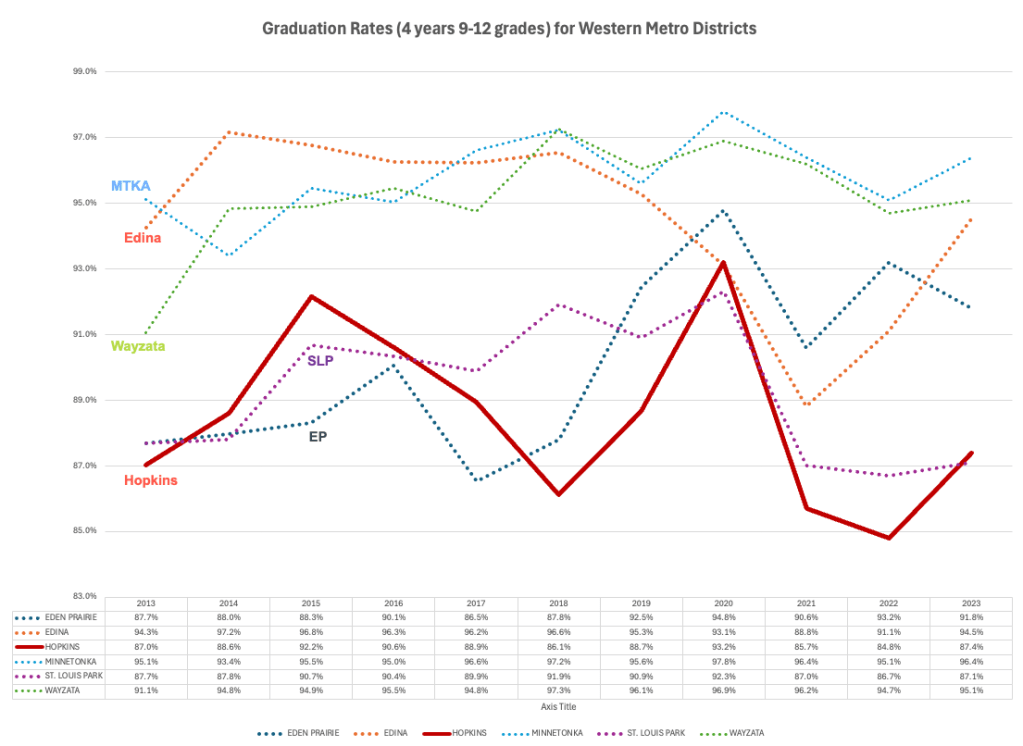
These metrics are based on the 4 year graduation rate. This rate tracks whether a student is graduating with their cohort. For example, students that enter the freshman class in Fall 2020 are expected to complete high school in four years and graduate with their cohort in June 2024. This metric accounts for students both leaving and entering the school during that four year window, without giving extra credit for students who transfer in or taking credit away for students that transfer out.
As you can see, Hopkins 270 students are graduating at a consistently lower four year rate than their peers (noting a spike in 2020 across the board, when some students who might have otherwise been held back were permitted to graduate with their cohort due to COVID).
2. Examining Predictors of Success Against Measurable Quantitative Test Scores
If Vision 2031 is working, if the changes implemented by the District Administration are moving us towards success, we would predict that our metrics will be improving year over year, and moreover we will be improving against others who are not following Hopkins lead on implementing new instructional practices that align with the vaunted personalized and inquiry based learning touted by the Administration and members of the School Board. If Vision 2031 is working, then when other districts are showing gains post-COVID, Hopkins should be as well, if not doing better. Correspondingly, if other districts are still facing post-COVID headwinds, with these new teaching systems being implemented under Vision 2031, Hopkins students should be holding steady and certainly doing better than they cohorts in other districts.
On the other hand, what would we expect to see if the critics (like me) are correct in our hypothesis that the new educational programs being implemented as part of Vision 2031 are failing our students? We would sadly predict year-over-year scores holding steady or falling, and Hopkins students falling behind their peers in other districts. For example, where students in other districts are holding steady or still falling post-COVID, critics of Vision 2031 would predict Hopkins 270 test scores to be falling faster and deeper. Finally, where students in other districts are recovering post-COVID, we would predict the data to show Hopkins kids either barely keeping up, or worse, continuing to fall behind their cohort.
3. A Decade+ of MCA Scores for MPLS West Metro
Now let’s move on to test score. Below is a summary of the MCA test scores for Math, Reading, and Science for five West Metro school districts from 2013 to 2024, with a breakdown of the average scores pre- and post-COVID.2 Clearly student progress suffered post-COVID across all districts, particularly in Science. However students in Hopkins 270–who were already scoring substantially behind the other West Metro districts pre-COVID–were impacted more than their peers.
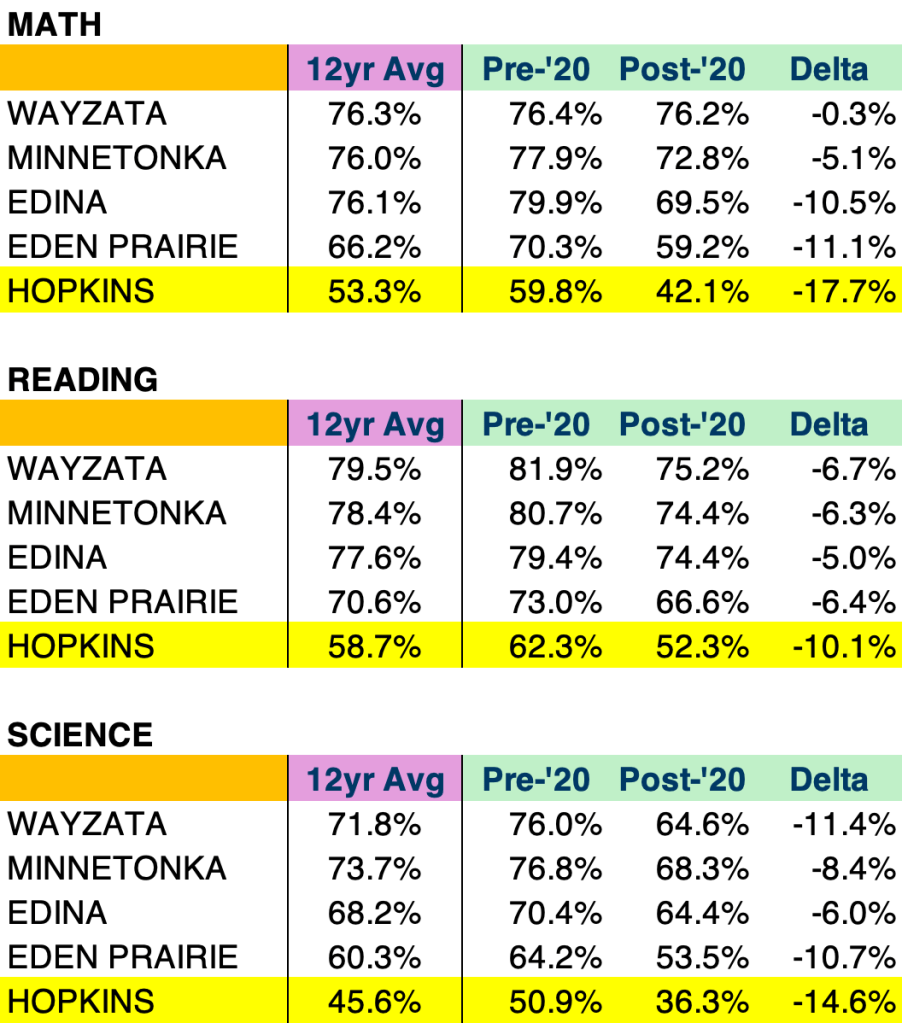
I have heard arguments from the defenders of Vision 2031 and the Hopkins 270 District Administration that it is unfair to compare the standardized test scores of Hopkins students to the students in these other West Metro districts for a variety of reasons. First, this ignores the reality that Hopkins 270 is not competing for students with School Districts outside the West Metro. Over 2,000 students who are residents of the Hopkins 270 School District are open enrolling to these neighboring West Metro districts, transferring needed revenue to these districts. Second, these criticism are based on a variety of assumptions that do not hold up when examining the quantitative data broken down by student demographic groups.
4. Measuring Across and Within Demographics
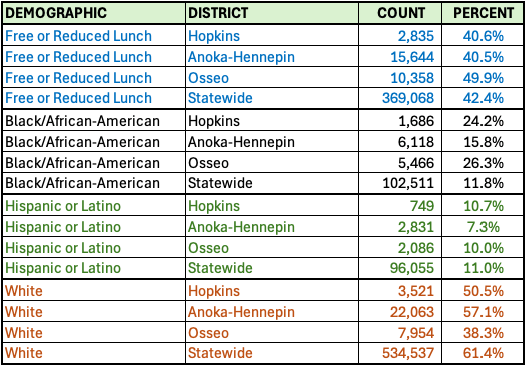
Some argue that comparing average standardized test scores, like those above, fails to account for historical and ongoing variances and disparities across racial and economic demographics. So I pulled data for the last four years from two other regional school districts outside the West Metro: Anoka-Hennepin (District 11) and Osseo (District 279). These districts have almost identical percentages with Hopkins of student enrollment that are eligible for free or reduced lunch. These districts also have higher than Statewide averages for Black student and Hispanic or Latino student enrollment, and lower than Statewide average enrollment percentages of White students. Below are the enrollment figures for all three districts, plus the Statewide averages, across the four selected demographics.3
The two sets of charts below examine the student proficiency scoring measurements for the four years 2021-2024 following the return to school in Fall 2021 post-COVID. The measurements cover the three core disciplines: 1) Math, 2) Reading, and 3) Science. The scores include the three school districts, Anoka-Hennepin 11, Hopkins 270, and Osseo 279, and the Statewide averages for comparison. Furthermore, I included a measurement of the 4 year change to compare how each district was recovering following the COVID shutdown.
Measurable Results Defy Vision 2031 Predictions
If Vision 2031 is working, resulting in equitable outcomes for all students, we should be seeing the test scores for Hopkins students of color and students eligible for free or reduced-price lunch going up over the last four years, both year-over-year, and moreover when compared to their peers in other districts. Similarly, we should not be seeing any negative impact to the scores for white Hopkins students.
Instead, the data shown below clearly demonstrates that Hopkins students are scoring at the bottom of each core academic subject (Math, Reading, and Science), and are on a negative trajectory year-over-year and falling behind their peers in all four demographic categories over the past four testing periods.
We start by looking at the percentage of students demonstrating proficiency in Math, Reading, and Science, organized by subject and then sorted by the four-year change between test scores from Fall 2021 (coming out of COVID) and the latest tests administered in Fall 2024. (As visual aid, Hopkins data is shown in Blue text and all negative change rates are in Red text with Red background).
Percentage of Students Demonstrating Subject Proficiency
(sorted by Subject and 4 year change 2021-2024)
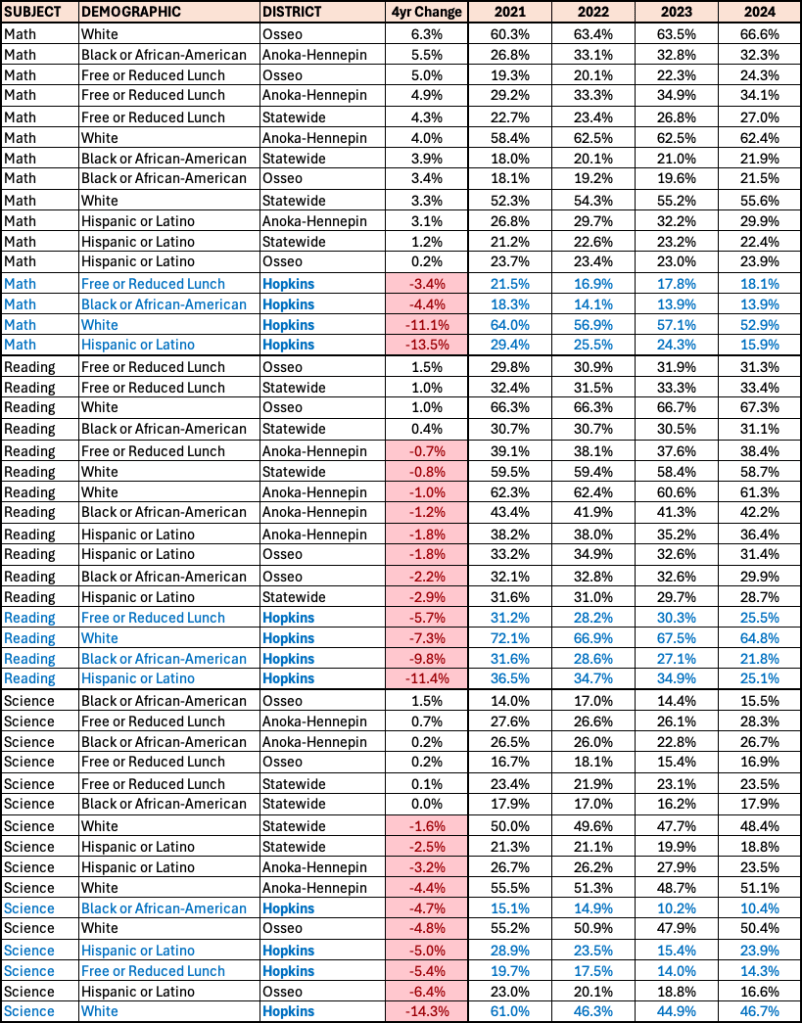
When we look at the same dataset reorganized by demographic group, we see that Hopkins students are falling faster and further within each demographic (Black/African American, Free or Reduced Lunch, Hispanic or Latino, and White) when compared to their peers within the same demographic group in Anoka-Hennepin 11, Osseo 279, and even against the Statewide averages.
Percentage of Students Demonstrating Subject Proficiency
(sorted by Demographic and 4 year change 2021-2024)
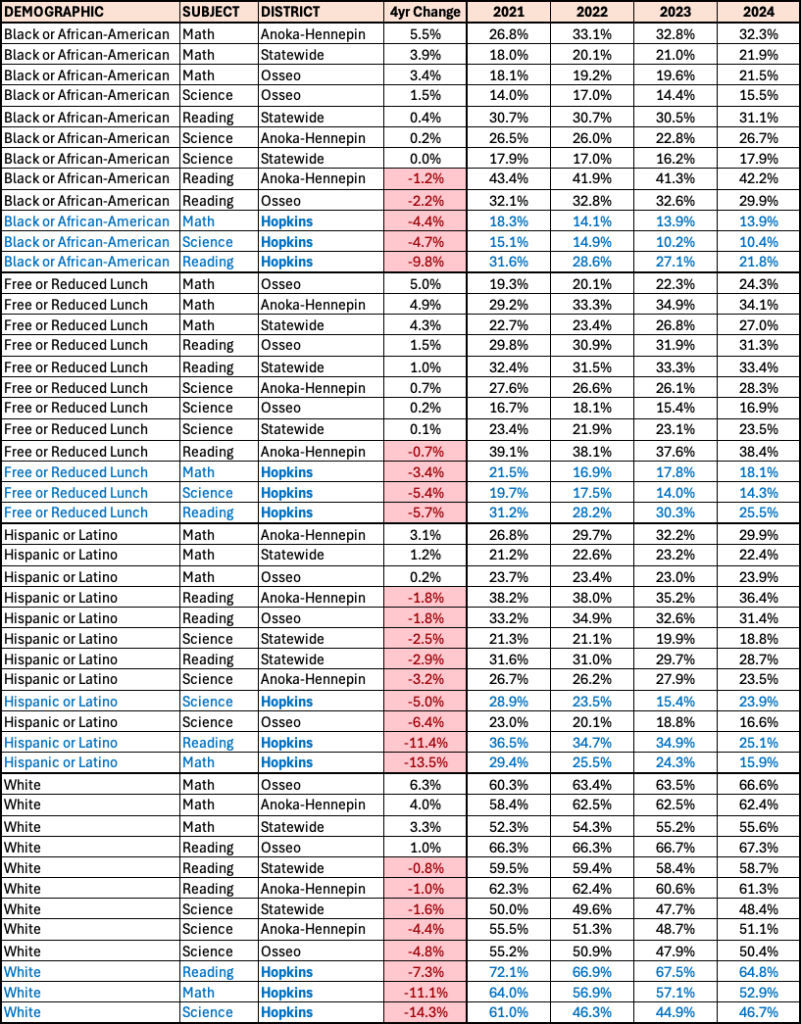
I have repeatedly heard claims that standardized testing is racist, classist, and fails to reflect that challenges of students from communities of color and the economically disadvantaged. Maybe. But how do you explain why students of the same demographic groups in the Anoka-Hennepin and Osseo school districts, as well as statewide averages for those similarly situated, all show improvements over the past four years while students in Hopkins 270 are falling behind? You certainly cannot explain away standardized testing as racist and classist when white students at Hopkins are falling behind their peers across all three core subjects.
Even if we accept as true that there are significant challenges with standardized testing, the above data disproves any claimed causal relationship between those challenges and the downward spiral in test scores we are seeing emerging in Hopkins 270 across all demographics following the introduction of Vision 2031.
Conclusion: Vision 2031 is Failing Hopkins Students Across Demographics
The fanatical approach of the Hopkins 270 District Administration and certain members of the School Board to reinventing education through the implementation of Vision 2031 is showing real-world harmful results. Not only is it negatively impacting a student body that was already behind its peers in other districts across the West Metro, but worse, it is causing damage to the educational needs of students that Vision 2031 was expressly designed to help:students of color and students of limited economic means who have historically been left behind.
- Minnesota Report Card, available at https://rc.education.mn.gov provides data from 2021-24. Additional sources for prior years is available through the MDE Data Center, at https://public.education.mn.gov/MDEAnalytics/Data.jsp . ↩︎
- I am happy to share a spreadsheet with the underlying data for all years from 2013-2024. If you’d like a copy, please email me. ↩︎
- MDE tracks a total of 12 different demographic groups: 8 race/ethnicity demographics (American Indian, Asian, Black or African American, Hispanic or Latino, Native Hawaiian or Pacific Islander, Other Indigenous Peoples, White, Two or more races) and 4 other criteria (English learner, Special education, Free/Reduced-Price emails, and Homelessness). To save time, I selected 3 of the larger race/ethnicity demographic groups and the largest of the other criteria demographic groups, which best represents students suffering from challenging economic impacts. If needed, I can add in and share the others, but it does take considerable time to assemble and validate. ↩︎




 Hopkins 270 Blog
Leave a comment