
I have previously discussed my learning of a 2018 Minnesota Department of Human Rights (MDHR) agreement with Hopkins 270 — and also with 40 other school districts and charter schools. In brief summary, these agreements were intended to address an identified correlative (not causal) pattern of “disparities in suspensions and expulsions for … students of color for non-safety related incidents.” [Source].1 I’ve also addressed my views on interpreting data on such disparities and the reporting by MDHR in 2022 on their findings following the implementation of the agreements. One thing I did note in that post was that I had other significant issues with MDHR 2022 Suspensions and Expulsions Report which I want to address here.
A Note on Exclusionary Discipline
There are two primary categories of school discipline: Exclusionary and Non-Exclusionary.
Exclusionary discipline = suspension or expulsion of a student from school.
Non-Exclusionary discipline = all other forms.
Broadly, there are constitutional and statutory requirements in Minnesota that require we provide school age children with access to public schools to obtain an education. When we forcibly exclude students from the classroom due to behavioral infractions, we are interfering with the duty to fulfill the legal requirements to educate them. While every adult reading this presumably understands the need to apply exclusionary discipline in schools, we need to recognize the legal requirements to minimize the use of such disciplinary measures.
MDHR’s 2022 Report – Switching Data Points
2018 MDHR agreements and the subsequent 2022 Suspensions and Expulsions Report 2 provide several conclusions regarding racial disparities in exclusionary discipline. In fact, the 2022 Report starts on pages 1-3 with addressing disparities in exclusionary discipline and then asserts that was the basis for the “Settlement Agreements” with 41 school districts and charter schools.
However, a close reading of the 2022 Report shows some strange data switching, as exemplified by the following infographic on from page 5:
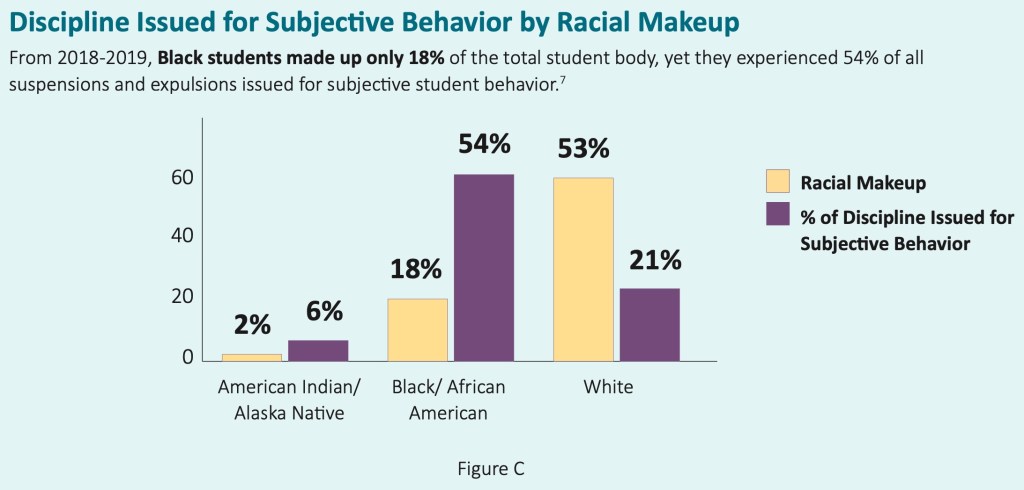
While this document is named “Suspensions and Expulsions Report,” when MDHR begins to show its data in infographics, we find that MDHR switches from Exclusionary discipline to Subjective bases for discipline. The department explains this switch by stating:
Subjective reasons such as “disruptive behavior” or “verbal abuse” are more ambiguous than objective reasons such as bringing a weapon to school. A subjection [sic] determination allows for ambiguity in the decision-making process, and bias can therefore play a significant role in someone’s decision to discipline a student.
My Issues with MDHR’s Switch from Exclusionary to Subjective Discipline Data
Starting with the most obvious: why would MDHR put out a 2022 report that is intended to show how it is handling supposed racial discrimination in the use of exclusionary discipline in the Minnesota Public Schools, but not use the data points it has collected on exclusionary discipline in the years following its touted, landmark set of agreements with 41 school districts and charter schools? Why suddenly change the measurement from exclusion to subjective disciplinary data points?
Diving into the specifics, MDHR relied on the MN Department of Education’s Disciplinary System Incident Reporting (DIRS) in performing its analysis and creating the above infographic. I have reviewed the 2023-24 DIRS Incident and Offense Types.3 There are a total of 31 Offense Types. 27 of 31 are either expressly defined or do not need definition, like Bomb Threat or Homicide, and can thus be presumed to be objective rather than subjective. That leaves only four that are subjective due to being ambiguous and undefined. In order of listed severity, they are: Verbal Abuse, Threat/Intimidation, Disruptive / Disorderly / Insubordination, and Other (everyone’s favorite).
MDHR offers no explanation for failing to provide the statistics on the remaining 27 objective Incident and Offense Types.
Conclusion
So much effort and resources have been expended based on the presumption that racial disciplinary disparities in the education system evidence either intentional discriminatory acts or implicit bias resulting in unintended, but real adverse impacts on students of color.4 It would be incredibly uncomfortable for many, including MDHR, the Minnesota Dept of Education, Education Minnesota, and others (like the Hopkins 270 administration and school board) if the data definitely demonstrated an inconvenient and uncomfortable truth: that students of color commit disciplinary infractions at a disproportionate rate to other students. Many of us, including me, might not want to believe that to be true, as we know would interpreted by the ugliest in our society as “proof” of a disgusting and manifestly racist stereotype that has harmed innocent individuals and communities of color for way too long.
Yet, if it turns out to be true — and we silence anyone who would dare to question the dogma on this topic — then we will, as a society generally and as members of the Hopkins 270 community, continue to put enormous resources and efforts on addressing the symptoms while failing to identify the root cause and resolve the real problem we have: our systems are failing to meet the mission of public education for too many students color.
[We might also have to face another uncomfortable truth: the solutions to the root cause may be well beyond the means our public education system.]
- Of note: other neighboring and nearby school districts included in that group were: Eden Prairie (South), Wayzata (North), Edina (East), St. Louis Park (East), Robbinsdale (North East), Richfield (South East, past Edina), Rosemount-Apple Valley-Eagan (past Richfield), along with the biggies Minneapolis and St. Paul and numerous surrounding districts. Interestingly, Minnetonka Public Schools were not included. One correlation that provides a possible explanation as to why Minnetonka wouldn’t have been included: The student body at the schools served by Minnetonka Public School District is reportedly 78.9% White, and only 2.8% Black. [Source]. ↩︎
- Source: https://mn.gov/mdhr/assets/Suspensions%20and%20Expulsions%20Report_tcm1061-529594.pdf ↩︎
- Source: https://education.mn.gov/mdeprod/idcplg?IdcService=GET_FILE&dDocName=prod083323&RevisionSelectionMethod=latestReleased&Rendition=primary ↩︎
- This is legally referred to as discrimination based “Disparate Impact.” If so inclined, just run that as a search term in your favorite internet search engine and you’ll get a ton of information. ↩︎





 Hopkins 270 Blog
Leave a comment