
In examining the application of exclusionary discipline in Minnesota schools, I found a rather lengthy publication from the Epic Educator Quality Innovation Center, the advocacy wing of Education Minnesota (the central organization providing advocacy for 477 teachers unions across Minnesota). This publication, Building an Equitable School System for All Students and Educators, contains a section titled: “Interrupting Racism, Strengthening Communities, and Accelerating Student Learning: The Need for Restorative Practices and Trauma-Informed Schools in Minnesota.”
Professional educators are the gateway to our future. They hold, what should be, a sacred place in our society (for which they should be much better compensated) and they should be thanked endlessly for the service and, often, sacrifice. Yet, reading through this publication, I was left to wonder two things: FIRST, why do the professional educators who wrote this piece think our education system should be the battle ground for the culture wars? SECOND, how do professional educators create a document that demonstrates so many fundamental flaws in the application of scientific principles and logic?
I have selected several quotes from the above-reference publication that exemplify my concerns with having our educators focusing on America’s culture wars rather than education.
But Look, Racism!
I will start with the following pull quote:
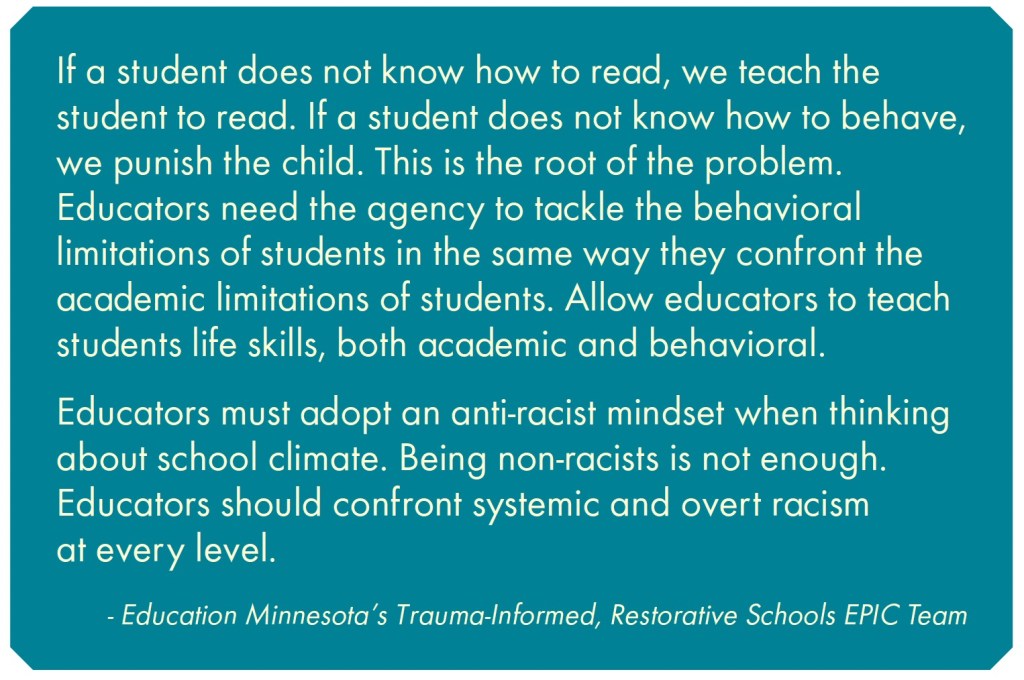
Here is my response:
- I agree with the first paragraph wholeheartedly! It completely aligns with the points that I made during the public comment period at the June 11, 2024 Hopkins 270 School Board Meeting.
- The first paragraph identifies the root of the problem being that we are failing to teach our students how to behave and instead just punishing them. BUT THEN, the second paragraph somehow states that the solution is to “adopt an anti-racist mindset when thinking about school climate.”
- The first paragraph establishes a premise irrespective of race or any student demographic group (single or “intersectional”).
- The second paragraph shows no logical connection to the first.
- So how does having educators “adopt an anti-racist mindset” teach children to behave in school other than through implementing punitive measures?
Absence of Proof is (somehow) Proof?
The paper then continues on the topic of disproportionate application of exclusionary discipline in our schools:
In addition, we want to begin with one important fact about research related to disproportionality in the use of exclusionary interventions. Students of color, LGBTQ+ students, and students with disabilities receive unequal numbers of punitive punishments, but there is no evidence that these demographics of students misbehave more than other students do.1 2
My response:
- The assertion that “there is no evidence” of something is not proof that evidence does not exist.
- The failure to falsify a hypothesis (students of the stated demographics misbehave more than others) is not proof that the hypothesis is false. That’s not how the scientific method works!
- We are not going to disrupt the cycle and end the disparate impact on students of color, LGBTQ+ students, and students of disability through implementing policies, programs, and procedures based on interpreting correlations and refusing to examine potential causal relationships.
- We should be establishing formal hypotheses that will allow us to assess why the disproportionality exists, and then assess each hypothesis through valid experimental testing to isolate and establish causal relationships.
The Passionate Love Affair with Correlation
The following related statement is found in the paper, a few pages down:
Minnesota lawmakers should be ashamed of the fact that “one out of every five or six Black students is suspended, but only about one out of every forty White students” is suspended and there is NO PROOF that Black children misbehave at higher rates than White students.3
My response:
- Minnesota lawmakers do NOT suspend or expel students from our schools.
- Teachers, staff, and administrators refer students for violations of the Student Code of Conduct.
- It is administrators, either at the school or within the district, that determine what discipline, if any, should be imposed, including exclusionary measures.
- What is the evidence that specific administrators in MN public schools (including Hopkins 270) are applying a “racist mindset”?
- If that evidence exists, then those administrators should be terminated.
Please Stop Projecting Your Own Implicit Biases!
So what is the presumed cause of the disproportionality in discipline? The paper argues that it is implicit human bias, writing:
“Even individuals who profess egalitarian intentions and try to treat all individuals fairly can still unknowingly act in ways that reflect their implicit—rather than their explicit—biases.” 4
My response:
- It is a reasonable hypothesis that we should subject to experimental testing.
- If proven true, it can be subject to controls, including, for example, added layers of due process and independent review boards.
- Maybe, just maybe, the implicit biases of these authors, as well as the well-meaning staff at the Departments of Education and Human Rights and the Hopkins 270 school district, are resulting in the inability to examine these issues through a scientific lens and instead project their personal, political beliefs about race in America to every school district in America.5
Conclusion
We are supposedly teaching our children about science, yet the adults running our educational systems seem to struggle with the concept of applying scientific principles and methodologies to solve complex challenges, like requirements for imposing discipline in our schools.
If scientific-based, validated, peer-reviewed studies demonstrate that acts of racism, explicit or implicit, are the root cause of disproportionate exclusionary discipline, then we need to identify the pathways to that undesired outcome are interrupted, including ensuring that individual professional educators causing the problem are provided remedial professional education or subject to disciplinary procedures with appropriate due process protections.
In the continued absence of actual evidence establishing a causal relationship between explicit or implicit racism of professional educators and the disproportionate exclusionary discipline imposed on students of color, maybe Educate Minnesota, and the administration of the Hopkins 270 school district, should to take a look in the mirror and check their own implicit biases.
- Building an Equitable School System for All Students and Educators, Epic Educator Quality Innovation Center, p.143 [available here] [hereinafter, “Building an Equitable School System”]. ↩︎
- The implicit argument in this statement is that there is no evidence to support the hypothesis that students in these demographics “misbehave” at a higher rate then students not these demographics, and therefore, a priori, it is proven that no causal relationship exists. ↩︎
- Building an Equitable School System, at 154. ↩︎
- Id. at 140. ↩︎
- To be clear, I am not suggesting that there are no active issues of race in America, Minnesota, or the areas and population that make up the Hopkins school district. It appears me that racism continues to impact our society on a regular basis in many ways. But the question presented here is whether racism, either overt or in the form of implicit bias, the root cause of the disproportionate application of exclusion discipline in Minnesota in general and Hopkins 270 in particular. ↩︎






 Hopkins 270 Blog
Leave a comment